


Economic Evaluation of Sugarcane Production: Impact of CBL Trials on Farmer ROI at DCM Shriram

1. Why Sugarcane Farming is Entering a New Era
For decades, sugarcane growers have been locked in a battle against frustrating yield plateaus. Despite advanced irrigation and traditional NPK regimens, many operations find themselves trapped in a cycle of subsistence margins. However, we are witnessing a pivot from these stagnation points toward industrial-scale surplus. The catalyst isn't more fertilizer; it is biostimulants-driven metabolic optimization. Recent field trials conducted by DCM Shriram Ltd. using CBL treatment across 24 diverse farming plots have revealed a fundamental shift in the crop’s economic potential. This data suggests that a targeted biological intervention can shatter historical limits, transforming the very architecture of the plant to favor both the grower and the processor.
2. The Yield Explosion: More Than Just Incremental Gains
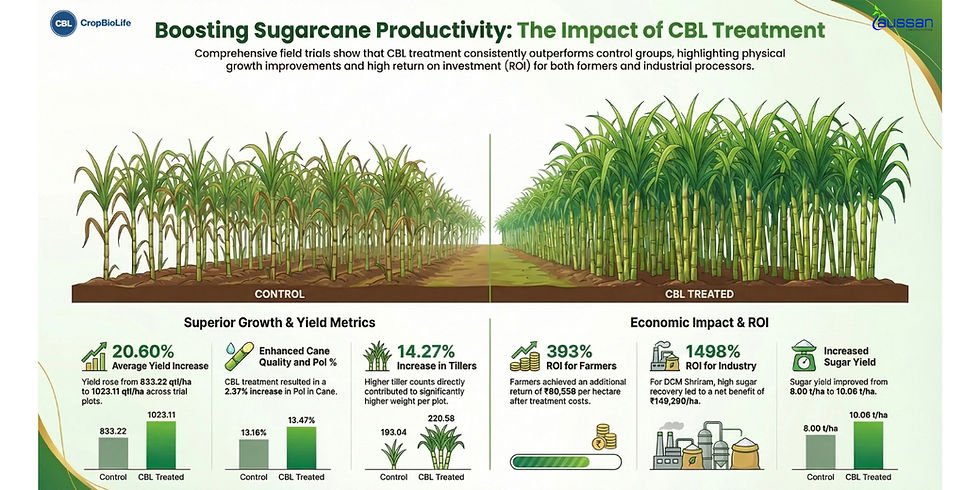
The DCM Shriram trial results represent a paradigm shift rather than a mere marginal improvement. Across a broad geographic footprint—spanning the units of Ajwapur, Rupapur, Hariawan and Loni—the data shows a consistent surge in productivity. While the raw trial average across 24 farmers showed a jump from 838.33 to 1011.00 qtl/ha, the refined economic analysis across these regions establishes a baseline of 833.22 qtl/ha for Control plots against a staggering 1023.11 qtl/ha for CBL Treated plots.
Increase in Yield: 189.89 qtl/ha
For a professional grower, an increase of nearly 190 quintals per hectare is statistically and practically transformative. This isn't just "bonus" cane; it is a massive expansion of total land-use efficiency, allowing farmers to produce significantly more volume from the same acreage.
3. The 393% Factor: A Masterclass in ROI
In the world of high-stakes AgTech, every input must be a profit center. The "Sugarcane Cost Benefit Analysis for Farmers" highlights a financial logic that is increasingly rare in commodity agriculture. The treatment protocol utilized a modest dose of 2L/ha. At a market rate of ₹400 per quintal, the resulting yield surge generated an additional gross income of ₹75,956. Even after accounting for the investment in the CBL treatment, farmers realized an additional net return of ₹60,556 per hectare.
This culminates in a massive 393% Return on Investment (ROI). In an industry defined by razor-thin margins, a nearly four-fold return on a specific input provides the financial headroom necessary for farm modernization and improved rural livelihoods.
4. Engineering a Better Plant: The Anatomy of Growth
This yield explosion was not an anomaly; it was the result of precise crop architecture enhancement. The data reveals a powerful biological compounding effect. By optimizing the plant's metabolic pathways, the CBL treatment targeted both the population and individual plant health simultaneously. The 189.89 qtl/ha gain is the direct result of the synergy between a 14.27% increase in tiller count (more stalks per hectare) and a 20.60% increase in individual stalk weight. When you have more plants and each plant is significantly heavier, the yield results are multiplicative rather than additive.
Growth Parameter | % Difference (Treated vs. Control) |
Average Weight | +20.60% |
Average Number of Tillers | +14.27% |
Average 3rd Node Diameter | +10.55% |
Beyond weight and population, the "Average DCM" data showed a 6.17% increase in cane height, proving that the treatment builds a more robust physical structure from the soil up.
5. Sweetening the Deal: Quality Meets Quantity
For the processor, volume is only one side of the coin; the real value lies in the "Pol in Cane"—a critical measure of sucrose purity. The DCM Shriram trials proved that CBL treatment doesn't just grow more cane; it grows better cane. Sucrose purity rose from 13.16% in control plots to 13.47% in treated plots.
This quality boost drove sugar recovery rates from 9.61 to 9.83. For the processor, this creates a "double-dip" in profitability: they are receiving more total tonnage and extracting more sugar from every ton processed. This explains the phenomenal 1498% ROI for the processor (DCM Shriram), representing a total optimization of the value chain from soil to silo.
6. Conclusion: A Provocative Future for the Sugar Belt
The consistency of these results—replicated across 24 different farmers such as Chandra Pal, Noor Khan, and Jay Kishor Dixit—demonstrates that these gains are resilient across varied management styles and soil types. From Ajwapur and Rupapur to the fields of Hariawan and Loni, the trend is undeniable.
As the industry looks to scale these biostimulants-driven interventions, the question for the modern agriculturist shifts: In a global market demanding higher efficiency and sustainability, can we afford not to adopt these metabolic optimizations? The data from the sugar belt suggests that the future of farming lies in the marriage of biological precision and economic aggressive-growth strategies.
Total Integrated Net Benefit (Rs/ha): ₹148,290


Comments